
Criminal Cases in Walker County Courts
Walker County divides criminal cases by jurisdiction. Superior Court is the main felony trial court. Walker State Court generally hears misdemeanor and traffic prosecutions. Magistrate Court issues warrants and handles early or limited criminal proceedings. Municipal courts in LaFayette, Rossville, and Chickamauga address city ordinances and authorized traffic matters, so a city citation may never appear in the Superior or State Court docket.
The Clerk at 103 South Duke Street in LaFayette maintains filed accusations and indictments, motions, orders, docket events, judgments, sentences, and certified dispositions for the courts it serves. A docket is the event index, not the whole file. It may show that an order was entered without displaying the image. When a summary leaves the result unclear, request the judgment or certified disposition. The Clerk is also the source for an official copy, while the arresting agency remains custodian of its own incident narrative.
Walker County Court Routing
The right counter depends on the record. The Sheriff's Office does not hold the Clerk's prosecution file, and the Clerk does not become custodian of a city officer's original incident report merely because charges are filed.
| Court | Criminal Role | Contact Route |
|---|---|---|
| Superior Court | Felonies and general jurisdiction | Clerk, 103 South Duke Street |
| State Court | Misdemeanors and traffic | Clerk, 103 South Duke Street |
| Magistrate Court | Warrants and early proceedings | 201 South Duke Street, 706-638-1217 |
| Municipal courts | City ordinances and traffic | Contact the named city court |
This split matters most for municipal citations and bench warrants. Start with the city court for those records. Use the Walker Clerk route for the Superior and State court files its office maintains. Magistrate Court publishes separate hours and a criminal clerk contact for warrant and preliminary-process questions. Its South Duke Street counter is not the same office as the trial-court Clerk.
How to Search Walker County Case Records
The Walker County Clerk docket portal is the direct online route for local Superior and State court entries. The Georgia Judicial Gateway is an access directory, not one complete statewide trial-court database. Search locally when Walker County is known, then use the directory if the county or court is uncertain.
- Open the Clerk portal and choose the criminal or docket path.
- Use the case number when known. Otherwise, enter the party name and narrow the dates or division.
- Confirm the court, filing date, and case number. A matching name alone does not prove identity.
- Read the charge and status with the event history. Open does not mean convicted, and disposed does not identify the result.
- Ask the Clerk for the accusation, indictment, judgment, sentence, or certified disposition when the summary is not enough.
| Field Label | Type | Required | Notes |
|---|---|---|---|
| Last name | Text | No | Use with other known details |
| First name | Text | No | Check spelling and aliases |
| Case number | Text | No | Best identifier when known |
| Date range | Date | No | Narrows common-name results |
| Court or year | Selector | No | Limits the docket set |
Walker County Circuit Context
The Lookout Mountain Judicial Circuit connects Walker County with Catoosa, Chattooga, and Dade Counties. Its published court information does not turn four clerks into one shared docket. A circuit calendar entry still must be matched to the county clerk holding the filed record.
The official circuit source is shown below. It identifies the judicial setting around a Walker County felony case.
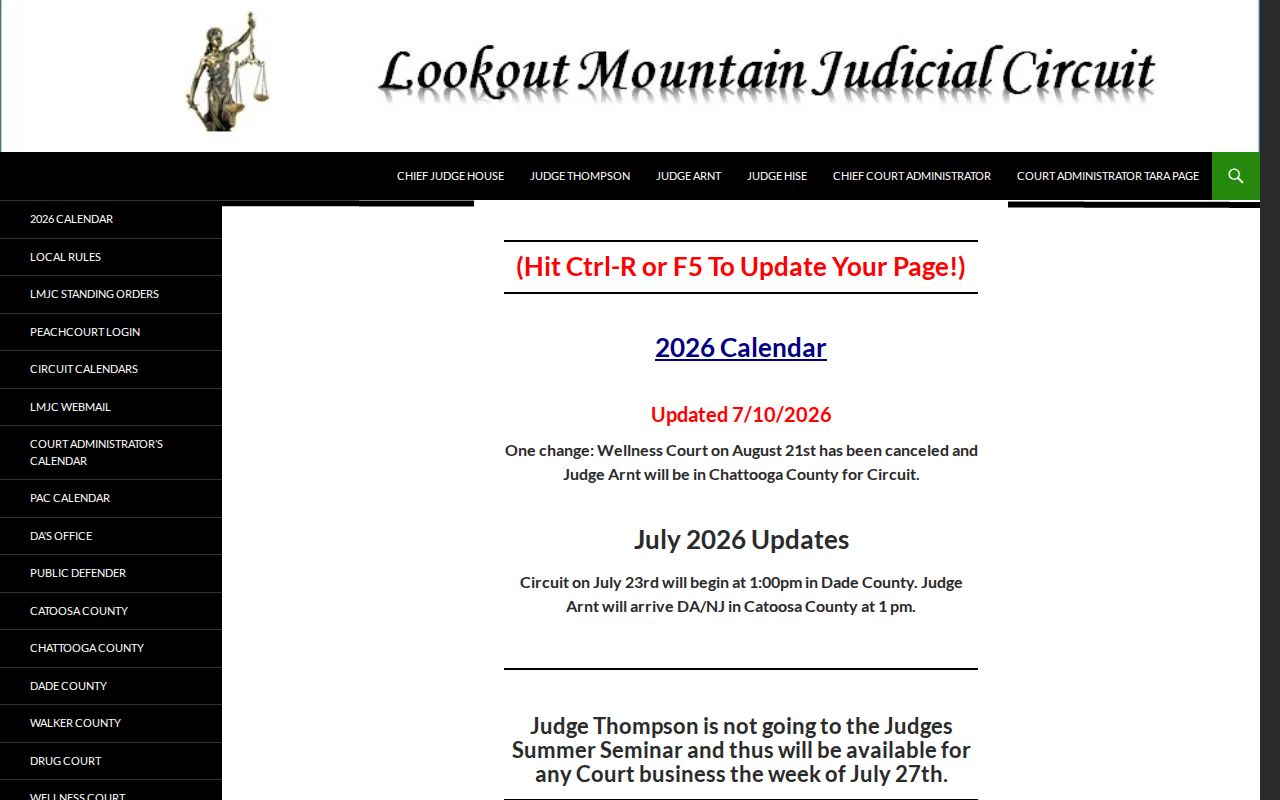
Use the circuit source for court information, then return to the Walker Clerk for docket entries, filed papers, copies, and certification.
What a Walker County Case File Shows
A Walker County case file builds a time line of the prosecution. The portal may identify parties, charges, hearings, and status, while the filed papers provide the legal detail. Document images and financial entries may vary. Sensitive identifiers, victim data, and juvenile material should not be assumed public merely because a docket exists.
| Case Number & Court | Identifies the docket and court division. |
|---|---|
| Charging Document | States the counts filed by accusation or indictment. |
| Docket Entries | Dates filings, pleas, orders, judgments, and other events. |
| Hearing Dates | Lists scheduled or recorded court settings. |
| Disposition & Judgment | Shows how each count ended and the formal ruling. |
| Sentence & Conditions | Records punishment and related terms after conviction. |
Reading Walker County Docket Status
Docket labels need context. Open does not mean guilty. Disposed means the trial-court matter reached an outcome, but the word alone does not tell whether a count ended in a plea, trial conviction, dismissal, nolle prosequi, or acquittal. Read the judgment for each count.
- Arraignment
- The hearing where the accused answers the filed charge.
- Nolle prosequi
- A prosecutor's formal choice not to continue a charge at that time.
- Disposition
- The recorded outcome of a filed count.
- Certified copy
- A copy authenticated by the Clerk as official proof.
Charges can change after arrest. The county's arrest history records trace booking and custody, while the Walker County judgment controls the outcome of the filed prosecution.
Stages of a Walker County Criminal Case
A Walker County prosecution may follow an investigation or arrest, but the trial-court file develops when a prosecutor files an accusation or presents an indictment where required. Early warrant and bond material may sit in Magistrate Court before the Superior or State docket grows.
Case flow: Charges Filed › Arraignment › Pretrial › Plea or Trial › Disposition › Sentencing
A case may end before trial through dismissal, nolle prosequi, or a plea. Trial can end in conviction or acquittal. Post-judgment motions and appeals may add later entries. A dismissal or acquittal is not a conviction.
Walker County Record Differences
A court docket, a GCIC criminal history, and a Sheriff's report answer different questions. The Walker County docket tracks one prosecution and its filed result. A GCIC history joins fingerprint-supported Georgia arrest cycles to reported dispositions. The Sheriff's report describes the agency's investigation or arrest. None should be treated as a complete substitute for the other two.
If a statewide history lacks a result that appears in the Walker County judgment, obtain the certified disposition and ask the submitting agency to send the correction. The source court proves the filed result. GCIC cannot create or change another agency's source data without documentation.
Walker County Certified Dispositions
The portal helps locate a file, but the Clerk supplies filed dispositions and certification. Ask for a specific judgment, sentence, accusation, indictment, or order instead of every page by default. Include the case number, court, party name, and approximate year when known. A focused request helps staff locate the correct record and quote the cost.
Walker County Clerk
Superior, State, and Juvenile Court records
103 South Duke Street
LaFayette, GA 30728
For an older or unimaged matter, ask about archive retrieval. No current copy or certification fee was established in the research, so request a quote from the Clerk. State the desired format and whether certification is required. A portal printout and a certified disposition serve different needs.
A certified disposition is especially useful when a Georgia criminal-history entry lacks an outcome or shows one that appears wrong. Compare the arrest tracking information with the Walker County case number and the judgment for each count. GCIC does not create the court's result and cannot change a source agency's data without support. Obtain the Clerk's document, then contact the court, prosecutor, or arresting agency that submitted the disputed item so it can report a correction through the proper channel. Keep copies of the request and the certified order. A docket screen can identify the file, but it may not carry the seal or authentication needed to establish the final result.
Walker County Case Access and Restrictions
The Georgia Open Records Act supports public access, while court rules and confidentiality laws govern court files. Walker County offers the docket and Clerk counter. A requester can seek public electronic copies, paper copies, or certification. Portal document access varies, and cost should be confirmed before ordering.
Sealed matters, juvenile files, protected victim facts, Social Security numbers, and other sensitive data may be withheld or redacted. Record restriction under O.C.G.A. § 35-3-37 can limit dissemination and permit sealing in qualifying matters, but it does not mean every source record is destroyed. Ask the Clerk for the filed order when a summary and source paper seem to conflict.
Specify the court division and approximate filing year when asking staff to locate an older Walker County case. Those details help distinguish similar names and reduce archive search time.
Note: A name match is a lead, not proof that the Walker County docket belongs to the person being researched.