
How to Check Criminal History in LaFayette
A LaFayette search starts by separating the city record from county custody and prosecution records. Police keep incident and arrest narratives. Municipal Court maintains city citations. Walker County records a jail booking and higher-court prosecution. No functioning official LaFayette report portal or municipal name-search portal was verified, so direct custodian confirmation is essential beforehand.
- Confirm the current LaFayette Police records custodian and request channel by telephone.
- Describe the report by date, location, report number, and exact public portion sought.
- Contact Municipal Court for a city citation or ordinance file.
- Use Walker Daily Jail Reports or AIS for booking, then the Clerk portal for a filed county case.
- Use Georgia Felon Search for its limited felony purpose or GCIC procedures for fingerprint-supported self-review.
The LaFayette Police Department
LaFayette Police creates reports for incidents it investigates and arrests its officers make. Records can include a report number, date, location, officer, allegations, narrative, evidence references, and arrest data. Public copies may omit confidential identifiers, juvenile information, protected victim details, and material whose release would harm an active investigation.
No current official online request form or arrest log was verified. Prepare date, time, location, involved names, report number, record type, and desired format. Ask for segregable public portions and a fee estimate. If another agency investigated, redirect the request rather than assuming a LaFayette mailing address proves city jurisdiction.
Arrests and Bookings in LaFayette
When a LaFayette arrest enters county custody, the Walker County jail creates a separate booking record. Use the Sheriff's Daily Intake and Daily Release PDFs for activity around a known date. For current custody, call AIS at 706-638-1909, press 3, then press 1, and search by last name or date of birth.
Processing may take eight hours or more. A police report remains with the arresting agency even after county booking. The jail's received charge is not proof of guilt and may differ from the accusation, indictment, or final disposition later recorded by the court.
LaFayette County Seat Records and Census Context
LaFayette is the Walker County seat. The 2020 Census counted 6,888 residents, compared with 7,121 in 2010, and Census QuickFacts gives a July 1, 2025 estimate of 7,157. The city covers 8.09 square miles of land, with 2020 density of 851.8 people per square mile. These figures describe the community, not its crime rate.
The official LaFayette Census QuickFacts source provides city context.
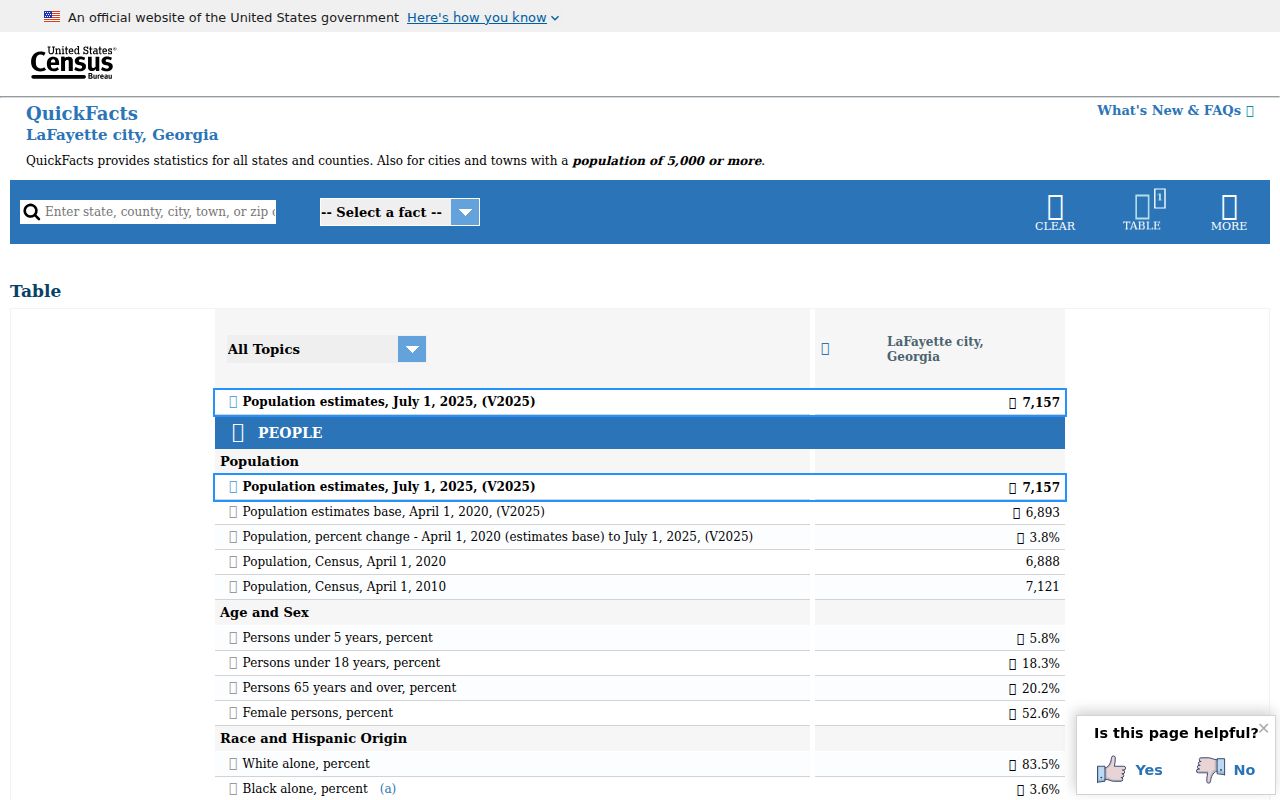
Keep LaFayette agency statistics separate from Walker County totals and label every year and dataset used.
LaFayette Municipal Court Records
LaFayette Municipal Court handles city ordinance matters and authorized traffic cases. It is not the Walker Superior Court felony docket or the State Court misdemeanor docket. No official public case-name lookup was verified. Contact the current Municipal Court custodian and ask how to identify a citation, inspect the docket, and request a copy.
| Court Name | LaFayette Municipal Court; 2025 official election results identify Kenneth S. Maples as judge. |
|---|---|
| Case Types Heard | City ordinances and traffic matters within municipal authority. |
| Case Lookup Channel | Direct Municipal Court contact; no verified public name-search portal. |
| What the Docket Shows | Citation or case identifier, charge, events, plea, disposition, and payment data when recorded. |
| Copies & Fees | Ask the current clerk for method and quote; no official fee was located. |
LaFayette Municipal Judge and the Court Route
Walker County's official 2025 election-results interface identifies Kenneth S. Maples as LaFayette Municipal Court judge. That election result establishes the officeholder shown for the election, but the results interface is not a case search and does not provide citation files.
The official municipal judge election result documents that limited fact.
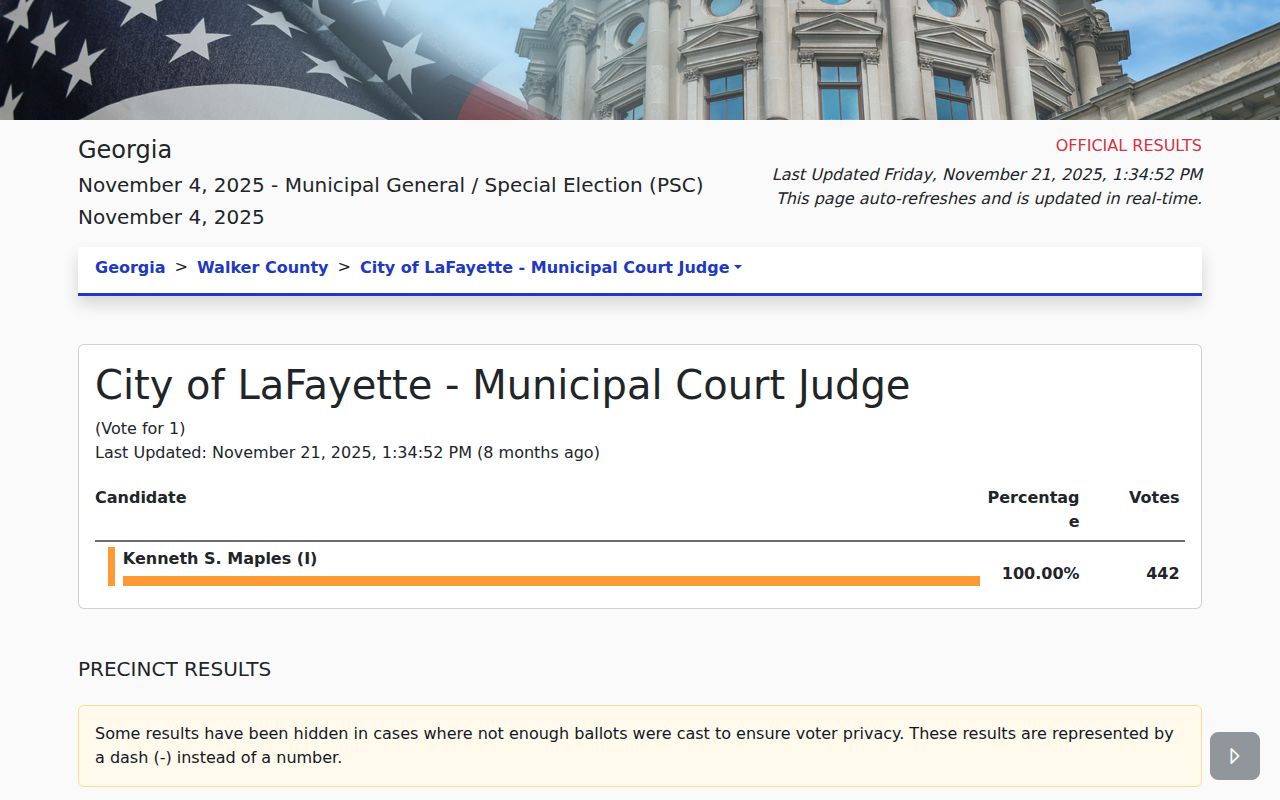
Use the Municipal Court clerk, not the election site, for a citation, hearing entry, disposition, or certified copy.
Where LaFayette Records End Up
A LaFayette officer's report stays with the city agency. If a person is transported to Walker detention, the Sheriff creates a booking record. A city citation stays in Municipal Court, while a felony or county misdemeanor prosecution creates a separate Walker Clerk file. Fingerprintable arrest data and reported dispositions can later enter GCIC.
Record flow: LaFayette PD › Walker County Courts › Georgia Bureau of Investigation (GBI), Georgia Crime Information Center (GCIC)
For recent activity, begin with the originating agency and county booking channels. For the filed charge and final result, use the correct court. For a reported statewide felony conviction, use Georgia Felon Search. For personal fingerprint-supported review, follow GCIC procedures.
LaFayette Police Report or Walker Booking Record
A police report describes the event, response, and asserted basis for an arrest. A Walker booking record describes jail intake, charges received, bond, and custody or release times. The two records are related but answer different questions. Neither establishes a conviction.
The county Sheriff publishes Daily Intake and Daily Release PDFs and provides AIS for current status. A later Walker Clerk docket can show whether prosecutors filed a charge and how it ended. If one source looks wrong, compare report identifiers, booking date, court case number, and disposition rather than relying on the shared name alone.
LaFayette Agency Statistics Need Reporting Context
The FBI Crime Data Explorer can be filtered to LaFayette Police Department. Any result should retain the chosen agency, year, offense category, and reporting-coverage notes. Walker County's 2024 GBI totals cannot be relabeled as LaFayette counts because county and city datasets have different geographic and agency scopes.
The official Walker County QuickFacts source supplies county population context, not LaFayette police activity.
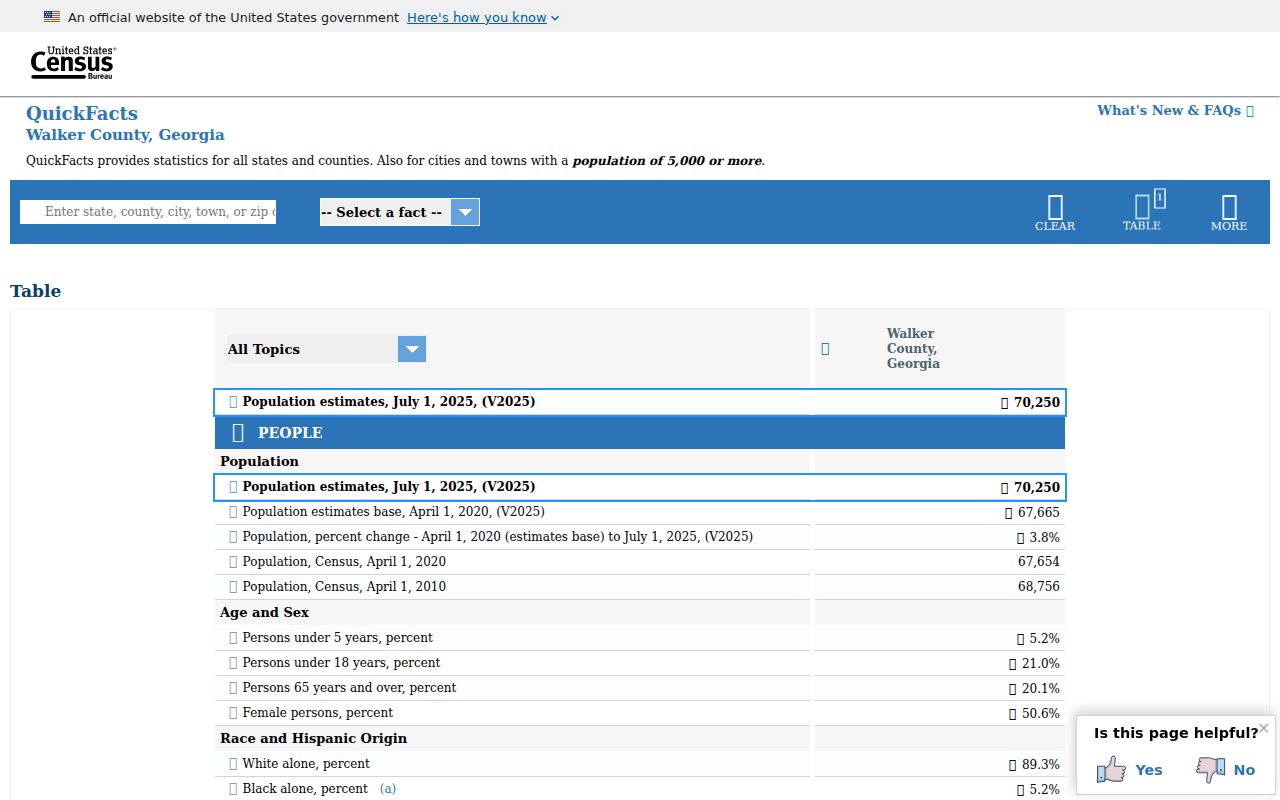
Use the county image only to explain scale and label it clearly so city and county measures are not blended.
LaFayette Investigations Can Cross Custodian Lines
Official GBI releases illustrate why a city label does not identify every record holder. A 2020 investigation requested by LaFayette Police followed a city audit involving city-court fines and fees and missing police money. The audit, police investigation, city-court financial record, and any resulting prosecution belonged to different record streams.
A March 25, 2025 cross-border murder investigation involved Walker Sheriff, GBI, federal or Tennessee authorities, and Hamilton County booking and extradition. A LaFayette connection did not place every custody or investigative document in one Georgia city office. Search the agency that created each record and the court or facility that actually received the matter.
Correcting a LaFayette Record Across Four Systems
A mismatch should be traced to the system that displays it. Start with the LaFayette police report if the arresting agency, date, identity, or asserted charge is wrong. Use the Walker booking record for a jail intake or release error. Obtain the municipal or county court disposition when the result is missing or a charge appears to remain open after the case ended. Then compare the GCIC self-review if the Georgia history still lacks the supported outcome.
GCIC cannot invent or change another agency's source data without documentation. A written source-agency update can use the person's full name, date of birth, Social Security number, race, sex, and arrest date, or SID and arrest date, or the Offender Tracking Number, together with the requested change. The exact route depends on which agency submitted the wrong or incomplete entry. A certified court disposition is the strongest document for proving the entered judicial result.
Georgia record restriction is different from correcting an error. For eligible older arrests, the subject completes Section 1 of the restriction form, the arresting agency completes Section 2, and the prosecutor rules in Section 3. If approved, the completed form and a $25 certified check or money order go to GCIC. Arrests after July 1, 2013 generally use a prosecutor route rather than the same application workflow.
Restriction limits dissemination for ordinary noncriminal-justice purposes but does not destroy every city, county, or state file. Court sealing is related and may require a qualifying order. A matter can therefore be correct in one source, restricted in another, and still visible on a public court docket until each applicable custodian receives the proper documentation. Keep copies of the disposition, restriction decision, sealing order, agency correspondence, and submission proof.
LaFayette Records Channel by Channel
A recent city incident begins with LaFayette Police, after confirming its present records contact. Ask for the incident or arrest report, not a generic criminal history. If the event resulted in county detention, use the Walker Sheriff's date-indexed Daily Intake and Daily Release reports. AIS is better for current custody after processing. The report and booking remain separate even when both concern the same arrest.
A city citation or ordinance matter belongs with LaFayette Municipal Court. A felony filing belongs in Walker Superior Court, and a county misdemeanor or traffic prosecution generally belongs in State Court. The Walker Clerk portal can be searched by case number or party name, with a date range or court division used to reduce false matches. An open status is not a conviction, and a disposed status must be followed to the actual disposition.
For an incomplete portal summary, request the accusation or indictment, judgment, sentence, or certified disposition from the Clerk at 103 South Duke Street. For a statewide public search of reported Georgia felony convictions, Georgia Felon Search requires full name, date of birth, race, sex, and payment. It is name based and charges for a no-record result, so it should not be treated as fingerprint proof.
For the subject's own fingerprint-supported Georgia review, follow GCIC instructions and the GAPS route through IdentoGO. For sentenced Georgia prison custody, use GDC Find an Offender. None of those statewide systems replaces LaFayette's police narrative, Municipal Court's city file, Walker jail's custody record, or the Clerk's certified local disposition. The question decides the channel.
Public Access Rules for LaFayette Records
The Georgia Open Records Act applies to public city records subject to exemptions, response rules, and reasonable costs. A focused request should seek the public portion from the office that created it. Active investigative content, juveniles, protected victims, confidential identifiers, and sealed or restricted material may be withheld or redacted.
Key Statutes:
Georgia Open Records Act, O.C.G.A. § 50-18-70 et seq. presumes access to agency records while allowing exemptions and reasonable search, redaction, and copy costs.
O.C.G.A. § 35-3-34(d.2) permits public access to reported Georgia felony convictions when full name, race, sex, and date of birth are supplied.
O.C.G.A. § 35-3-37 establishes Georgia record restriction and related court-sealing procedures.